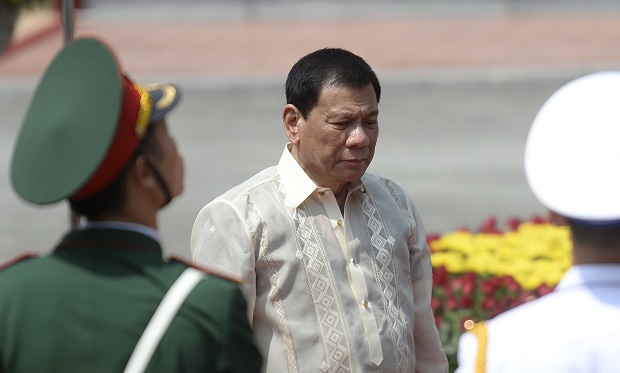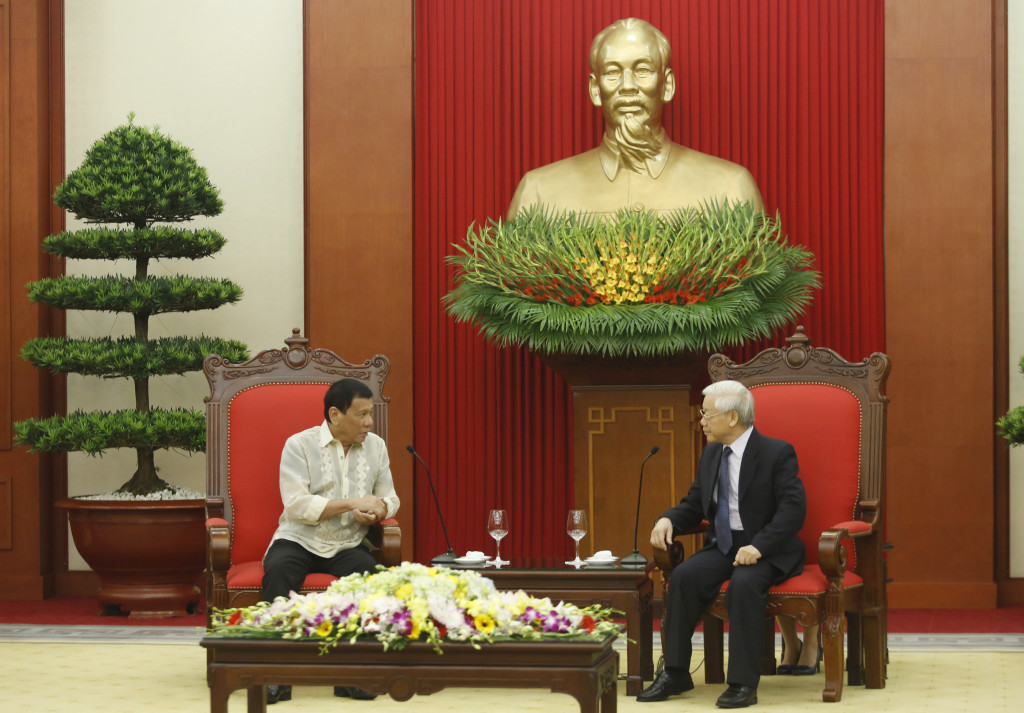
Philippine President Rodrigo Duterte, left, talks with Vietnam’s Communist Party General Secretary Nguyen Phu Trong at the Party’s headquarters in Hanoi, Vietnam, Thursday, Sept. 29, 2016. AP HANOI—President Duterte has invited more Vietnamese businessmen to invest in the Philippines, and to consider importing more Filipino products to boost two-way trade. The President made the pitch in bilateral talks with Vietnam State President Tran Dai Quang on Thursday at the State Palace of Vietnam. Both countries “agreed to really level up the trade that we have by increasing trade numbers,” Trade Secretary Ramon Lopez, who was part of the president’s delegation, told a press briefing. “The President invited Vietnamese corporations to invest in the Philippines. We’ll protect your investors and your investments, contracts will be honored,” Lopez said, adding that Mr. Duterte gave assurances that Vietnamese investments would be protected and the government would provide a more conducive investment climate. The President arrived at the State Palace at 10 a.m., Thursday, to military honors and an official welcome by Tran. Earlier in the morning, Duterte took part in a wreath-laying ceremony at the National Monument for Heroes and Martyrs in Hanoi. Aside from Tran, he met with Vietnamese Prime Minister Nguyen Xuan Phuc and Nguyen Phu Trong, general secretary of the Central Committee of the Communist Party of Vietnam. Apart from being Southeast Asian neighbors, the Philippines and Vietnam are both claimants to disputed territories in the South China Sea, which are being claimed by China. Vietnam earlier expressed support for Read More …
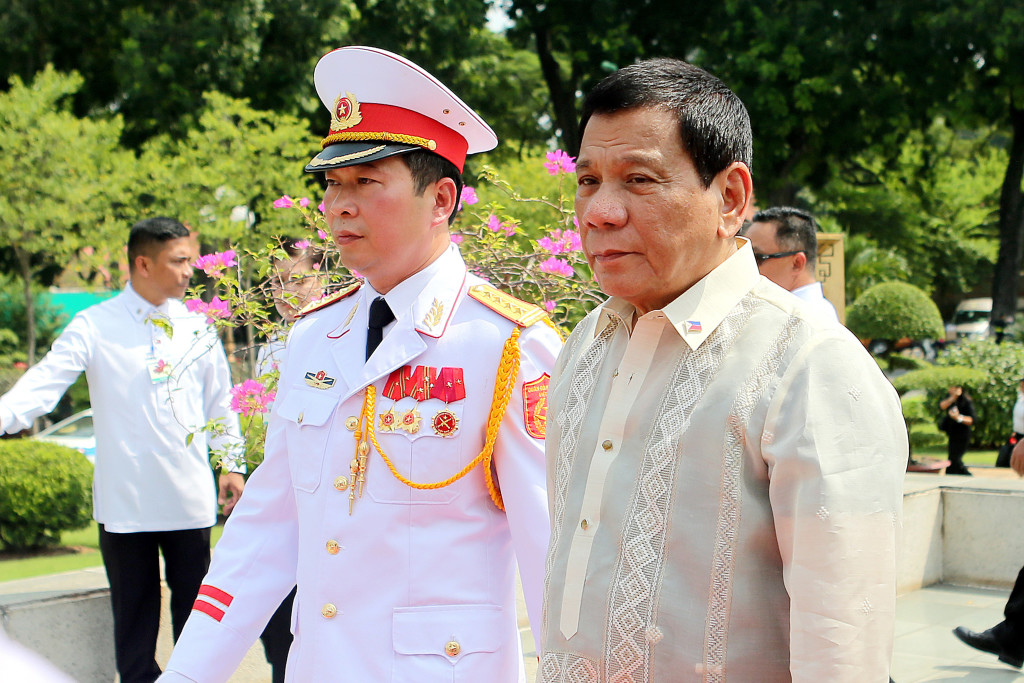
Philippine President Rodrigo Duterte, right, attends a wreath laying ceremony at the Monument of National Heroes and Martyrs in Hanoi, Vietnam, Thursday, Sept. 29, 2016. AP HANOI—Officials of the Philippines and Vietnam have agreed to fast-track the finalization and implementation of a code of conduct (COC) to ease tensions in the South China Sea. Foreign Secretary Perfecto Yasay Jr. said claims to the disputed territories was one of the topics of discussion in President Duterte’s talks with Vietnamese leaders during his two-day official visit here. Both the Philippines and Vietnam claim parts of the South China Sea, which is being claimed in its entirety by China. Yasay said the position of both countries on the handling of the dispute was “convergent” and that “there is no conflict.” “We’ve agreed like the Association of Southeast Asian Nations, of which the Philippines and Vietnam are members, to respect the rule of law, international law and the United Nations Convention on the Law of the Seas,” Yasay said. “Together we agreed to fully implement the Declaration of Conduct that was signed by all Asean members in 2002, and to proceed on a fast track with the coming out of a COC,” he said. Yasay made the statement in a press briefing on Thursday after Mr. Duterte’s meeting with top Vietnamese leaders. During his conversation with Vietnamese President Tran Dai Quang, Mr. Duterte explained the necessity for the Philippines to have bilateral talks with China on the territorial dispute. For its part, Vietnam pushed Read More …
Philippine President Rodrigo Duterte reviews an honor guard with his Vietnamese counterpart Tran Dai Quang during a welcome ceremony at the presidential palace in Hanoi, Vietnam, Thursday, Sept. 29, 2016. AP DAVAO CITY – President Rodrigo Duterte said the United States must stop its criticism of him, particularly in connection with the extrajudicial killings tied to his war on drugs, by saying it should “not pretend to be the moral conscience of the world.” “Do not be the policeman because you do not have the eligibility to do that in my country,” he said. Earlier, US Senator Benjamin Cardin of Maryland said in a dialogue with Senator Patrick Leahy of Vermont, that “in advocating and endorsing what amounts to mass murder,” Duterte has taken the wrong way in dealing with the illegal drugs problem. “Senator Leahy is absolutely right when he said that a lack of respect for rule of law and democratic governance breeds instability, distrust, and sometimes violence,” Cardin said. But Duterte said the US was being hypocrite and urged it to “stop it.” “Why are you shooting the black people there when they are on the ground? he asked. He also said the US and it’s allies, such as Britain, also violated the human rights of other countries, such as when they invaded Iraq “on the flimsy excuse that there was a weapon of mass destruction there.” “They’re only good at criticizing,” he said, calling them pea-brained. Duterte said the criticisms have been going on for years Read More …

“I could see more and more on a larger scale that this guy had absolutely no respect for institutions, had no understanding of what policy meant, had no appreciation of planning and was running (the country) like a small town.” The person being referred to was a president of the Philippines. No, it was not Rody Duterte. The “guy” in the quote was Joseph Estrada. Erap was overthrown just a few weeks after Karina David, the academic activist who served as his housing czar, described to me her tumultuous stint as a member of Erap’s team. Erap was like Duterte in many ways: a popular tough-talking maverick with a macho swagger who presented himself as a man of the masses. Erap won the support of many well-known activist social reformers like David and former rebels, Horacio Morales and Edicio de la Torre. And so has Duterte. In fact, the progressives on Digong’s team, some of them respected veterans of the fight against the Marcos dictatorship — led by Cabinet Secretary Jun Evasco and Social Welfare Secretary Judy Taguiwalo — are considered one of the hopeful signs that the Duterte era could be a period of meaningful reforms. That certainly was the hope during the first six months of the Erap presidency in 1998. It was a time of optimism when the country appeared to have a president who was serious about addressing issues of poverty and social injustice. “The first six months were to me inspiring,” David told me. Edicio Read More …
The Town of Banff, Alberta, Canada, a busy tourist area, has many Filipinos working in its hospitality industry. JHONG DE LA CRUZ RED DEER, Alberta – Various communities here and their stakeholders are trying to understand the use of crystal meth by some newcomers to Canada, particularly Filipinos. A possible link between work-related stress and the use of crystal meth, more commonly known by Filipinos as “shabu,” is being examined in a series of community discussions that began in summer in the tourist town of Banff, Alberta. A scathing news by CBC.ca this month reported that some members of the Filipino community in Banff are using crystal meth. Their usage was identified as a coping strategy to handle work-related stress. But the work-stress link appears to be part of a bigger picture, said Meagan Stewart, coordinator for Bow Valley Immigration Partnership (BVIP). “The idea that shabu might be used in the Bow Valley to cope with multiple jobs is speculation. At this time, we are seeking to learn more about how and why it might be used,” she said. BVIP, a community partnership of stakeholders from the communities of Banff, Canmore, Lake Louise, Kananaskis and Western M.D. of Bighorn, assist with immigrant settlement and integration in the Bow Valley region. Small number A few members of the Filipino community had reported to BVIP’s partner organizations about their use of shabu, or of somebody they know who was using shabu, said Stewart. “We also learned that very few of Read More …
Atty. Rodel Rodis tells ecumenical service attendees that the number of victims of extrajudicial killings in the 14 years of martial law under President Marcos figures has been surpassed by the reported 3,800 deaths in the two-month-old Duterte presidency. JUN NUCUM DALY CITY, California – Filipinos here marked 44th anniversary of the declaration of Martial Law with an ecumenical prayer service and community discussion in Daly City “to remember the victims of martial law,” which signaled the dictatorship of the late Ferdinand Marcos. They also prayed for the current victims of human rights violations, particularly the victims of alleged extrajudicial killings (EJKs), which are on the rise in the Philippines with President Duterte’s war on drugs. They reiterated their opposition to President Duterte’s plan for a hero’s burial to dictator Ferdinand Marcos at the Libingan ng mga Bayani. Participants later broke into smaller groups to talk about what they could do “as Filipinos residing in the U.S., to respond to the EJKs, and to the current threats to civil liberties and democracy in the Philippines due to the seduction of strong-man, dictatorial rule.” Kontra Libing coalition member Ago Pedalizo says that the extrajudicial killings happening right now are reminiscent of martial law. JUN NUCUM While the organizers of the event in a statement welcomed President Duterte’s invitation to the UN Special Rapporteur, the European Union and the United States to probe allegations of extrajudicial killings in the Philippines, they also “called on President Duterte to take all steps to ensure Read More …
AAAJ/INQUIRER FILE PHOTO WASHINGTON, DC — A free, interactive search and visualization tool for data on the 50-plus Asian American and Pacific Islander population is now available courtesy of the AARP Public Policy Institute. AARP DataExplorer allows users to browse and search for data on issues like demographics, health, financial security, housing and transportation by indicators including age, race/ethnicity, state, income, health status, and languages spoken. “Data is critical to understanding the issues and needs of Asian American and Pacific Islander communities,” said Daphne Kwok, AARP Vice President of Multicultural Leadership, Asian American and Pacific Islander Audience Strategy. “AARP DataExplorer is an easy tool for those looking for data on AAPI older adults to find relevant facts and figures which can be customized to fit their needs—whether it’s researching trends or patterns at the state or federal level, or driving policy solutions,” Kwok added. Users can create their own, customized visualizations of the data that can be turned into PDFs or PowerPoint slides and downloaded as images to use in reports or projects. The AARP DataExplorer site also offers a “Storybooks” feature that provides context for some of the data and helps users understand the story behind the data. AARP DataExplorer presents the most current data and indicators and add new ones as soon as new data are available. No data programming skills are needed. To use AARP DataExplorer and watch a video tutorial to learn how to customize the data and visuals, visit dataexplorer.aarp.org. Latest Bilibid riot probers careful Read More …
CHICAGO – In 2009, the US Congress through the House of Senate and House of Representatives respectively passed H. Res. 780 recognizing October 2011 and every October thereafter as Filipino American History Month (FAHM). Starting in 2011, the Philippine American Cultural Foundation (PACF) spearheaded a move to organize a variety of events to celebrate FAHM. The Filipino American National Historical Society (FANHS) announces “1946: A Turning Point” as the theme for this year. This to commemorate the 70th Anniversary of events and pieces of legislation that transformed the lives of Filipinos such as the following: The Rescission Act of 1946 barred veterans in the Philippines from receiving GI Bill benefits The Luce-Celler Bill on July 2, 1946 granted access to naturalization for all Filipinos who had come to the US before March 1934 however immigration was limited to 100 per year. Philippine independence from the United States was granted on July 4, 1946. Oct 1 to Oct 31: Art and Anthropology: Portrait of the Object as Filipino*. Display of 10 paintings and creation of collaborative mural by 5 FilAm artists from Chicago and 5 artists from the Philippines. Field Museum of Natural History Chicago, 1400 S. Lakeshore Dr. Events take place during museum hours. (Almira [email protected]) OctNov15:Focusing (Vol. II)is a continuation of Alejandro T. Acierto’s exploration of the breath through the colonial history of Filipino involvement in the 1904 World’s Fair. at Corner 2912 N. Milwaukee Ave. (storefront) Chicago, IL 60618 -, Call Grace Needlman, 216-533-2824,[email protected] Oct 1, Sat., 9am – 10am – Opening of month long FAHM exhibit display at Bank Financial 1354 E 55th St, Chicago, IL 60615. (Email Estrella Alamar [email protected] –FAHSC) Oct 1, Sat., 11am – 1:00pm – 2016 FAHM Celebration Kickoff at Read More …
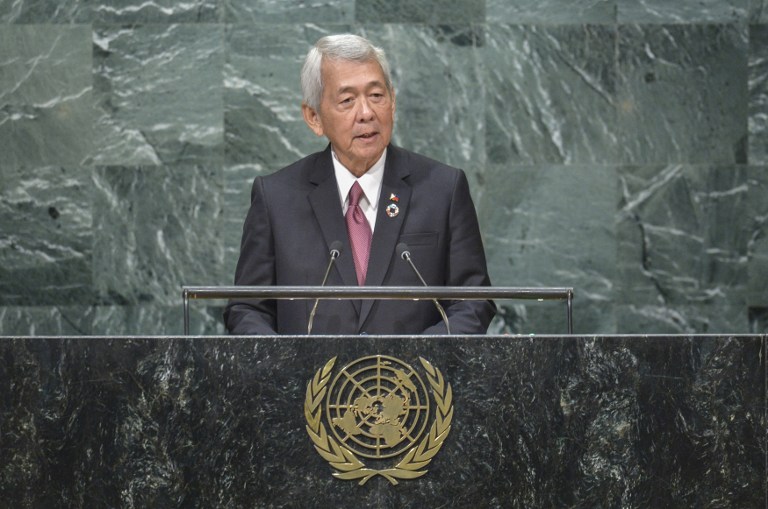
Perfecto Yasay, Secretary for Foreign Affairs of the Philippines, addresses the 71st session of the United Nations General Assembly at the UN headquarters in New York on September 24, 2016. AFP UNITED NATIONS, United States — The Philippines’ foreign secretary on Saturday pushed back against criticism of President Rodrigo Duterte’s drug war, telling the United Nations not to interfere. “We urge everyone to allow us to deal with out domestic challenges in order to achieve our national goals, without undue interference,” Perfecto Yasay told the UN General Assembly. There has been growing international alarm over the rising death toll from Duterte’s crackdown on crime, with human rights groups saying that security forces are engaging in extrajudicial killings. READ: Duterte hits ‘stupid’ UN criticism of PH anti-drug campaign | Duterte won elections in a landslide in May after vowing to eradicate the illegal drug trade in six months, and promising that 100,000 criminals would be killed in the process. Since he took office on June 30 about 3,000 people have been killed, about a third of them suspects shot dead by police and the rest murdered by unidentified attackers, according to police statistics. “We have not and we will never empower our law enforcement agents to shoot-to-kill individuals suspected of drug crimes,” the foreign secretary told the General Assembly. “Extrajudicial killings have no place in our society, and in our criminal justice system.” READ: DFA: UN, EU envoys should follow PH protocols in drug slays probe The top diplomat told the General Assembly that Read More …