More and more celebrities acknowledge the huge impact of the Internet on their lives.
Apr 112014
More and more celebrities acknowledge the huge impact of the Internet on their lives.
Julian Estrada, Bodie Cruz, and other celebrity kids walks the runway at the Philippine launch of shoe brand NÃO Do Brasil.

President Benigno S. Aquino III troops the line during the 72nd commemoration of the Araw ng Kagitingan (Day of Valor) at the Dambana ng Kagitingan, Mt. Samat Shrine in Pilar, Bataan on Wednesday (April 09, 2014). This year’s theme is “Balik-Tanaw sa Sakripisyo ng Beterano, Gabay sa Landas ng Pagbabago”. (MNS Photo) MANILA (Mabuhay) – The United States on Wednesday reiterated its commitment to stand by the Philippines, its long-time ally, in the face of threats – a statement that could have extra meaning in light of recent developments in the territorial dispute between Manila and Beijing. “As treaty allies, when the Philippines faces threats or natural disasters, so do we,” said US Ambassador to the Philippines Philip Goldberg during his speech at the commemoration of the Araw ng Kagitingan in Bataan. Goldberg did not mention specific threats, but his speech came at the time of increasing tensions between the Philippines and China over overlapping claims in the South China Sea. Relations between the two Asian neighbors hit a low point when the Philippines sought arbitration in January 2013 to try to declare as illegal China’s massive claim over the South China Sea because it overlaps with Manila’s territories. In his speech, Goldberg instead explained that the shared “history of sacrifice” between Filipino and American troops during World War II “forges the special relationship” of the two countries. “As shown in history and present until this very day, we can and will continue to work together shoulder to shoulder to Read More …
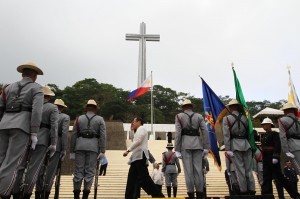
President Benigno S. Aquino III, accompanied by Armed Forces of the Philippines (AFP) Chief of Staff General Emmanuel Bautista, troops the line upon arrival at the Dambana ng Kagitingan, Mt. Samat Shrine in Pilar, Bataan on Wednesday (April 9, 2014) for the 72nd Commemoration of the Araw ng Kagitingan (Day of Valor). This year’s theme is: “Balik-Tanaw sa Sakripisyo ng Beterano, Gabay sa Landas ng Pagbabago.”(MNS photo) MANILA (Mabuhay) – Japanese Ambassador to the Philippines Toshinao Urabe used the commemoration of the Araw ng Kagitingan on Wednesday to apologize for Japan’s role during World War II, saying it has learned its lesson from those days. “Seventy-two years have passed. Still, it hurts to remember the hardship and pain suffered by so many during those fateful days. I wish to express our heartfelt apologies and deep sense of remorse for such inexplicable suffering,” Urabe said during his speech at a program in Bataan. He said Japan has learned the “valuable lesson” from history that using force does not solve anything. “It only creates problems. That is why we have vowed never to wage war never again,” he said. This, he said, is the reason for their actions in the last seven decades. “Fortunately, the Filipinos have accepted to move on. We have been building the future together ever since. Thanks to the efforts of our predecessors, we are now strategic partners sharing common values,” he said. Urabe specifically cited the exchange visits between the two countries, Filipino and Japanese soldiers working Read More …

Tuesday, April 29, 2014 9:30 am – 10:45 am Fowler A139 UCLA Campus Los Angeles, CA 90095 Free and open to the public. Out of Borneo: The role of slavery in the peopling of the Philippines, Lecture by Roderick G. Orlina, PhD Candidate, Asia Research Centre, Murdoch University (Australia) http://web.international.ucla.edu/ Lecture by Roderick G. Orlina, PhD Candidate, Asia Research Centre, Murdoch University (Australia) One of the most glaring omissions in Philippine historical discourse is the legacy of slavery in shaping the nation’s demographic. Discussions have tended to revolve around Moro raiding, which continued well into the colonial period and wreaked havoc on the non-Muslim population and the Spanish Crown. However, historical evidence suggests that it was a widespread practice that predated Islam. In addition, early European sources point to Borneo as the origin of some of the main ethno-linguistic groups that inhabit the Philippines. Drawing mainly on linguistic and historical data, Orlina argues that pre-colonial migration was much more complex than previously thought and challenges notions of cultural identity in the Philippines. Roderick Orlina received his BA in Linguistics and Religious Studies from the University of Stony Brook and his MA in Islamic Studies from the University of the Philippines, Diliman. He is currently a PhD Candidate for Asian History at the Asia Research Centre, Murdoch University, completing a dissertation on everyday life in early colonial Manila. His research interests include Southeast Asian epigraphy, religion, language and folklore. Sponsored by the UCLA Department of Anthropology.

©Lasse Kristensen/shutterstock.com (PARIS-AFP) – French and German researchers on Wednesday said they had found evidence in the lab to back theories that drinking caffeine has a preventive effect on Alzheimer’s disease. In mice, regular doses of caffeine inhibited the growth of tau, a protein that clogs brain cells in Alzheimer’s patients, they said. The discovery was made among mice that had been genetically modified to produce tau. They were given a tiny dose of caffeine — 0.3 grammes per litre (0.005 ounces per pint) — in their drinking water over 10 months. This is roughly equivalent to two cups of coffee per day for human beings. The mice were compared with an identical group of “tau” rodents which did not get the caffeine dose. “Mice that were given caffeine were less affected in terms of memory and tau buildup but also in terms of inflammation of the brain tissue,” said David Blum of France’s National Institute of Health and Medical Research (Inserm). Previous research has found that older people are less likely to suffer cognitive decline if they take regular, moderate amounts of caffeine. Experiments have also found that caffeine slows memory loss in mice bred to develop so-called amyloid plaques — another compound buildup in the brain that is associated with Alzheimer’s. The study appears in the US journal Neurobiology of Aging.
The secret of Richard Gomez and Lucy Torres to staying fit and healthy.

Members of the Ayungin Marines pay a courtesy call to Vice President Jejomar Binay at Coconut Palace. FRANCES MANGOSING/INQUIRER.net MANILA, Philippines – “Don’t lose hope,” a soldier previously assigned at BRP Sierra Madre tells future men who will be assigned there. Marine First Lieutenant Mike Pelotera led eight soldiers at the BRP Sierra Madre, a rusting ship that serves as the Philippine Navy detachment in Ayungin Shoal in the disputed West Philippine Sea, a resource-rich territory claimed by China but is within the Philippines’ exclusive economic zone. Pelotera’s team was surrounded by water for five months and he said the assignment was “a test of sanity.” Soldiers stationed in Ayungin usually serve for only three months. The nine-man Marine team was recently replaced by fresh troops last March, a second attempt for a rotation that month. On March 9, the Philippine government tried to resupply and bring new soldiers, but Chinese vessels surrounding the area blocked them. The next attempt on March 29, a Philippine civilian ship finally got past Chinese blockade after a two-hour standoff. “If they didn’t make it, we would have been stuck again,” Pelotera told INQUIRER.net. The rotation had been stalled because Philippine ships could not get past Chinese blockade. The soldiers at BRP Sierra Madre had to be content with airdrops. For five months, the soldiers at BRP Sierra Madre were not able to communicate with their families. “They have to endure loneliness,” Pelotera advised future soldiers of Ayungin. “But as time passes by, you Read More …
DEVELOPMENT of the first two phases of the 146-hectare (ha) Poro Point Freeport Zone in San Fernando, La Union will cost around P1.3 billion, the state-run Bases Conversion and Development Authority (BCDA) yesterday said.
TRADE between the Philippines and China will not likely be affected by the heightening territorial conflict between the two countries over portions of the South China Sea, government and industry officials yesterday said.