MANILA, Philippines – MMPC Auto Financial Services Corp. (MAFS), the auto-financing joint venture between Mitsubishi Motors Philippines Corp. (MMPC) and BDO Leasing and Finance Inc. (BDOLF), aims to cover all 49 Mitsubishi dealership outlets in the Philippines by the end of March next year. “We just started in Metro Manila. But we are gradually expanding our coverage area nationwide,” said MAFS president and CEO Mikihisa Takayama. Currently, MAFS has business in 16 Mitsubishi outlets in Metro Manila and surrounding areas. The company earlier projected it would finance a total of 20,000 car units by 2020 or about 20 percent of MMPC’s 100,000 car sales target for that year. Takayama said MAFS’ entry into the auto financing business would enhance Mitsubishi’s sales through its flexible loan products and fast application process. “We believe our operation can be very effective, he said, adding the application could be processed as fast as one day. Business ( Article MRec ), pagematch: 1, sectionmatch: 1 Takayama said they could be more lenient on the downpayment charged to car consumers since MAFS is a non-bank financial company. “We are more flexible and free so we can consider lower downpayment from the usual 20 percent. But I can’t say how many percent yet because we are still in the start-up period,” he said. Dante Calma, first vice president for MMPC’s marketing division, noted the preference of consumers to purchase cars through loans, rather than cold cash. He said the ratio of consumers who favor financing options has Read More …
MANILA, Philippines – Government infrastructure spending grew the fastest in six months in September, putting the year-to-date result on track toward government’s target for 2016, data from the Department of Budget and Management (DBM) showed. A total of P57.7 billion was disbursed for capital outlays, up 63 percent from P35.4 billion in the same period a year ago. The growth rate marked the fastest since March’s 65.1 percent For the first nine months, outlays stood at P439.7 billion, up 40.4 percent, representing 4.2 percent of GDP, slightly down from 4.3 percent as of June. “For the month of September, disbursements rallied behind strong infrastructure and other capital spending…,” DBM said in a statement on its website. “Disbursements for the first three quarters of 2016 (were also) boosted by the huge infrastructure and other capital expenditures,” it said. Capital outlays include actual infrastructure spending and fund transfers to local governments and state corporations for such purpose. Business ( Article MRec ), pagematch: 1, sectionmatch: 1 Data showed four agencies prompted the surge in September led by the Department of Public Works and Highways that paid for maintenance of existing roads. The Education and Health portfolios, meanwhile, constructed and upgraded school buildings and state hospitals. Military acquisition of the Department of National Defense also contributed, DBM said. Still, DBM said underspending was still obvious, although this was “expected,” given the transition and adjustment to the new administration. Procurement delays as well as late submission of documents by contractors also stopped agencies to Read More …
President Rodrigo Duterte is on his way to Peru for the 2016 Asia-Pacific Economic Cooperation Leaders’ Summit. Facebook/Presidential Communications Office President Rodrigo Duterte is on his way to Peru for the 2016 Asia-Pacific Economic Cooperation (APEC) Leaders’ Summit. On Thursday, the president said that he would spend his time in Peru promoting the Philippine economy and his 10-point socio-economic agenda, saying “the Philippines is open for business.” The president’s continued support for greater cross-border economic connections is particularly welcome, given the anti-trade attitudes that are on the rise in other parts of the world—especially the United States. This year’s theme of “Quality Growth and Human Development” builds on the priorities laid out by the Philippine government during its hosting last year. Although APEC was originally established to promote trade liberalization in the Asia-Pacific region, it has since prioritized agendas that highlight the importance of investing in human capital to build sustainable and inclusive economies. In recent years, the uneven distribution of growth has alienated the majority, leading to the rise of populist leaders around the globe. Despite an average economic growth of 6.1 percent over the last six years, the past administration failed to reach their target poverty incidence of no more than 18 to 20 percent. Pervasive inequality helped usher in the rise of Duterte, who pledges to lift millions of Filipinos from poverty. As world leaders are set to convene in Lima, we must reflect on the promise of growth, the future of trade, and APEC’s role in ensuring more Read More …
LIMA, Peru — A new world order led by China and Russia may be emerging in the Asia-Pacific region but the United States “still is arguably the most powerful nation on Earth,” Foreign Secretary Perfecto Yasay said Thursday. Speaking to reporters on the sidelines of the Asia-Pacific Economic Cooperation (Apec) ministerial meetings, the country’s top diplomat acknowledged the shift in power dynamics and geopolitics in the region following such developments as President Rodrigo Duterte’s pivot toward Asia and the election of billionaire Donald Trump as the next US president. But he said such developments did not necessarily mean US influence in the region was waning nor that it would refrain from exercising its influence with Trump taking the helm. “They have just shifted their priorities, and there have been some responses insofar as the shift of priorities is concerned… The rebalancing has generated some kind of concern but I think America even in spite of changes in the leadership as a result of the recent elections will continue to lead,” Yasay said “The United States arguably is still the most powerful country, nation, on earth, and it will continue to exercise its influence. I understand that in retaining that influence or the maintenance of the influence will be in pursuit also of its paramount national interest,” he said. But Yasay said change had indeed come in Asia Pacific, partly as a result of China’s more assertive posture and growing economic might. “[While] others think that there is geopolitical shift insofar as Read More …
LIMA, Peru — The Philippines will continue to honor its Enhanced Defense Cooperation Agreement (Edca) with the United States. In a meeting on the sidelines of the Asia-Pacific Economic Cooperation (Apec) Leaders Meeting here, Foreign Secretary Perfecto Yasay said he communicated with US Secretary of State Rodrigo Duterte the assurance of President Duterte of the continuation of the Philippines’ defense cooperation with the United States. “The President has assured America we will continue to respect our treaty agreement and the supporting agreements with respect to the Mutual Defense Treaty. We will continue with Edca,” Yasay said in a briefing for Filipino journalists after the Kerry meeting. The country’s top diplomat met with his US counterpart, along with Trade Secretary Ramon Lopez. In October, Duterte threatened to stop the implementation of Edca, saying it was under government review. The President also reminded the US government that it was just an executive agreement. READ: Angry Duterte threatens to end Edca Signed in April 2014 under the Benigno Aquino III administration, Edca allows US troops access to military bases and camps in “agreed locations” in the Philippines. Yasay clarified that Mr. Duterte “never said anything about discontinuing Edca.” “In fact during his inaugural speech, he said he would continue to respect our Mutual Defense Treaty and other supporting documents, including Edca,” the official said. What Duterte had stressed, however, was that the cooperation with the US would no longer be focusing on the area of “joint military exercises that would be demonstrative of preparing ourselves Read More …
THE Philippines will be among the hardest-hit economies should the US adopt protectionist trade policies, Moody’s Investors Service said in a report, which could dampen the prospects of the burgeoning business process outsourcing (BPO) sector that employs over a million Filipinos.
THE Philippines rose 11 places in a global ranking of ease of tax compliance for businesses, according to the World Bank Group (WB) and PricewaterhouseCoopers (PwC).
CHINA is interested in developing at least one industrial economic zone in the Philippines, promising to shoulder most of the expenses as part of the “quick turnaround” of the countries’ bilateral relationship, a trade official said.
Incensed at foreign criticism of his brutal war on drugs, President Rodrigo Duterte on Thursday threatened to follow in Russia’s footsteps and pull the Philippines out of the International Criminal Court (ICC), the UN-backed tribunal that handles cases involving war crimes, genocide and crimes against humanity. Like Russia, the Philippines has drawn ICC warning because of extrajudicial killings in Mr. Duterte’s campaign against illegal drugs. On Monday, the ICC angered Moscow by referring to Russia’s annexation of Ukraine’s Crimea region in 2015 as an armed conflict. The court is also examining allegations of war crimes committed by Russian and Georgian forces during a brief war in 2008. Russia is also under pressure for its bombing of opposition forces fighting President Bashar Assad in the Syrian civil war. An angry Russian President Vladimir Putin signed a decree on Wednesday to withdraw Russia from the ICC. The Russian foreign ministry explained that the court “failed to match the hopes one had and did not become a truly independent and respected body of international justice.” ‘Shameless bullies’ Speaking in his hometown, Davao City, shortly before flying to Peru for the Asia-Pacific Economic Cooperation (Apec) summit, Mr. Duterte said: “They (the Russians) may have thought the International Criminal Court is useless, so they withdrew their membership. I might follow. Why? Because these shameless bullies only pick on small countries like us.” Mr. Duterte’s comments came just two days after he told reporters that he was excited to meet Putin, who he said was into Read More …
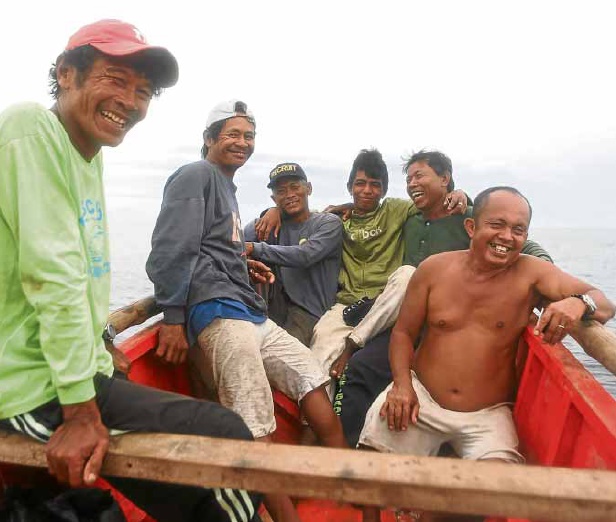
PANATAG SHOAL—Filipino fishermen have continued to sail back to this traditional fishing ground despite the presence of six Chinese Coast Guard vessels. On Monday, the fishing boat Bhuboy reached Panatag Shoal and anchored less than a kilometer from the Chinese vessels. China and the Philippines have reached a “friendly understanding,” and Filipinos may now fish at Panatag, internationally known as Scarborough Shoal. Still, the fishermen said they did not want to risk any confrontation with the Chinese coast guards. “Let us not go any closer to the ships. The [Chinese Coast Guard] might drive us away,” said Mattias Pumicpic, 55, captain of the Bhuboy. His boat ferried reporters to the shoal, including a team from the Inquirer. From the boat, Pumicpic could see two white Chinese vessels guarding the mouth of the shoal. Also within sight were four Chinese Navy ships. Just fishing About 200 meters from Pumicpic’s boat, another fishing vessel manned by Filipino fishermen was moored near the shoal. “We are here only to fish. Let’s not do anything that will make the Chinese angry,” Pumicpic said. As long as Filipinos can freely fish near the shoal, there is nothing wrong with Chinese vessels patrolling the area, he said. “If the Chinese coast guards won’t harass and drive us away, I don’t have any problem concerning their presence here,” he said. But unlike Pumicpic, most of his crew members want all the Chinese vessels to leave the shoal. “Scarborough Shoal is ours. Those Chinese should not be here. Read More …