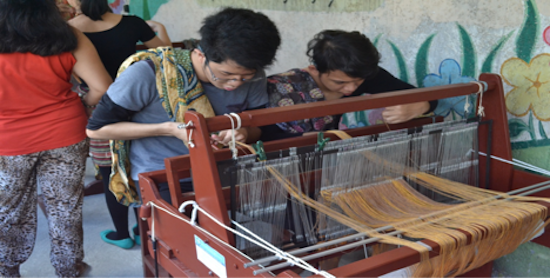
Special needs students can now work with portable therapeutic handlooms designed to develop their physical, mental, and social abilities. Special needs students using handlooms [via DOST] The Portable Therapeutic Handloom features a hand-held lever that takes the place of pedals, to facilitate the interchange of harnesses during weaving of yarns. With this strategic mechanism, the handloom will now only require eye-hand coordination thus streamlining the handweaving process. Ten of these special handlooms designed by the Philippine Textile Research Institute (DOST-PTRI), in collaboration with the Department of Science and Technology-National Capital Region (DOST-NCR), were turned over St. Francis School-VSA Arts Philippines for special needs students. This PTRI-designed technology is envisioned to aid the productivity of St. Francis School-VSA Arts students, as they design and create their own fabrics. Many of their outputs are developed into apparel, accessories, and other merchandise. Through this project, PTRI and DOST-NCR hope to empower them with livelihood opportunities, apart from therapeutic rehabilitation. Established in 1996 with the assistance of Japan, St. Francis School-VSA Arts specializes on special-needs education through various approaches—particularly speech and language development. Their K-12 curriculum is enhanced with extra-curricular activities, such as dancing, martial arts, acting, and urban weaving; providing their students other avenues of learning and expression. Their urban weaving program highlights saori, the Japanese art of handweaving that focuses on unique, freestyle designs, made by the school’s special needs students. Its premise is to provide them with creative therapeutic expression; the more mistakes, the better. Rebecca Santos, Executive Director of St. Read More …