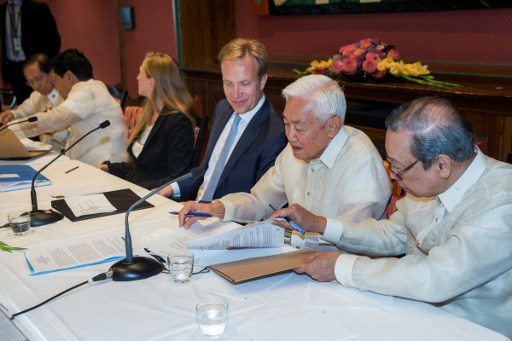
FILE- Phillipines Presidential Peace Adviser Jesus Dureza (R) and then- Chairman of the National Democratic Front of Philippines Luis Jalandori (C) sign a joint declaration next to the Norwegian Minister of Foreign Affairs Boerge Brende (L) in which both parties undertake unilateral ceasefires without time constraints on August 26, 2016 in Oslo, Norway. AFP PHOTO Update OSLO – After a delay in the discussions, both the government and the National Democratic Front of the Philippines finally reached an agreement in crafting a common draft framework and outline for the Comprehensive Agreement on Social and Economic Reforms (CASER). The parties decided to take a break just after a half day of discussion on Friday following a disagreement on the outline of CASER Julie De Lima, chairperson of the NDFP-Reciprocal Working Committee-SER, earlier said that the outline “should be based on addressing the roots of the armed conflict while the GRP wants an outcomes-based outline.” “We have exchanged with the GRP an outline of a comprehensive drafte on social and economic reforms that includes agrarian reform, national industrialization, environmental protection, rights of the working people, foreign economic and trade relations, and, monetary and fiscal policies,” De Lima said. The government prepared a 9-point outcome and proposed that it be included in the Part 1 or Declaration of Principles of the agreement. After a series of discussions and back channelling following the break, both parties were able to make concessions and craft the common draft. Instead of including it on Part 1, the points Read More …
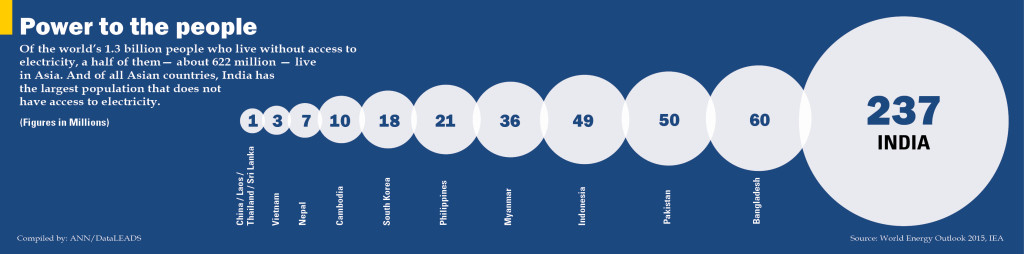
Around 526 million of the world population without access to electricity can be found in Asia, with India having the biggest chunk at 237 million, according to data from the International Energy Agency (IEA) compiled by the Asia News Network. But when compared relatively to the size of its population, India’s electrification rate was at 81 percent, higher compared to other countries like Myanmar, Cambodia, Philippines, Bangladesh, and Pakistan. According to IEA data, the Philippines has 21 million people without access to electricity, which constitutes around 21 percent of the country’s population. Bangladesh, Pakistan, Myanmar, and Indonesia have 60 million, 50 million, and 49 million people respectively without access to electricity. China, Thailand, Laos and Sri Lanka have been moderately successful in providing access to power to their citizens, with each country just having one million people without access to electricity. A total of 1.3 billion people in the world have no access to electricity according to the IEA. YG/JE/rga RELATED STORIES Electricity bills to rise this year Electricity rates to decline in October — Meralco TAGS: Asia, data, electricity, Energy, population, Power For feedback, complaints, or inquiries, contact us.
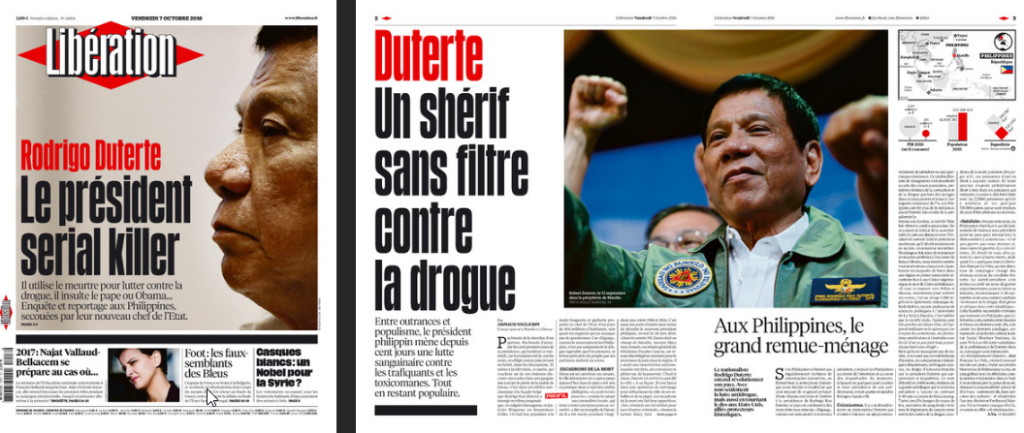
Screengrab from www.liberation.fr A French newspaper has tagged President Rodrigo Duterte as a “serial killer president” amid a piling body count in the administration’s bloody war on drugs. Duterte landed on the front page of France’s “The Liberation” daily, which featured the Philippine government’s relentless antidrug drive in its four-page story. The article also touched on Duterte’s expletive-laced statements against US President Barack Obama and Pope Francis, and his controversial remarks that drew parallels with Adolf Hitler’s killing of Jews and the war on drugs. READ: Duterte ‘Hitler’ talk reaps international censure In a radio interview on Sunday morning, Interior Secretary Mike Sueno said the “serial killer” tag against Duterte was “very unfair.” “Kung hindi ito ginagawa ni Pangulong Duterte, magiging narco-state tayo… Sa aming pananaw, walang extrajudicial killings dito dahil karamihan sa mga namamatay ay ‘yung mga lumalaban sa kapulisan,” Sueno told radio DZMM. (If President Duterte doesn’t do this, we will become a narco-state. In our point of view, there are no extrajudicial killings here because most of those who die are those who fight the police.) The Liberation was among the latest foreign media outfits that reported on the Duterte administration’s antinarcotics campaign, which continued to draw international attention amid criticisms of suspected extrajudicial killings and human rights abuses. International publications like The Guardian, TIME, The New York Times, and the Washington Post previously featured different aspects of the war on drugs. Duterte and his men have repeatedly criticized the foreign media for supposedly spinning his statements. As of Read More …
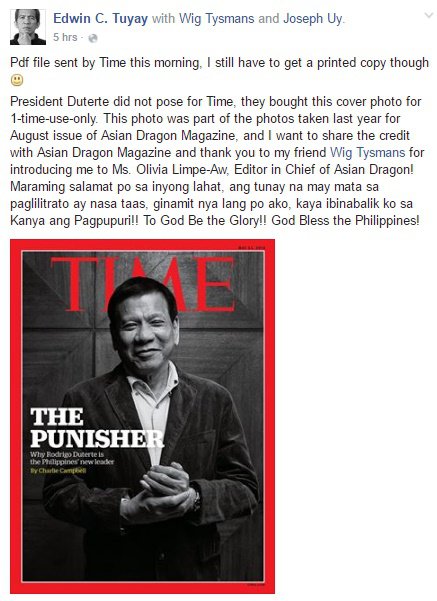
SCREENGRAB FROM EDWIN TUYAY’S FACEBOOK From being dubbed Asia’s latest strongman, the Philippines’ new President Duterte has ensnared the imagination of the foreign press in the three months he has been the leader of this mostly Catholic nation with his deadly and unrelenting antidrug war. Often described as “foul-mouthed” and the “Filipino Donald Trump” for his acerbic tongue, the man who once graced the cover of Time magazine as “The Punisher” has found fresh infamy among foreign reporters who have descended on Manila to cover the daily bloodletting of suspected drug pushers and users found lifeless in its dimly-lit and grime covered streets. At present, the police data keepers put the toll at over 3,600 dead, more than half of whom labelled as “deaths under investigation”—a euphemism for those killed by unknown vigilantes since Mr. Duterte assumed power in July. The rest were killed in violent police encounters, their bodies typically found beside an old .38 caliber pistol. At least two—a father and son—were killed inside a police station where the cops said they had struggled and tried to fight it out. The President has officially denied endorsing the killings, but in visits to police and military camps around the country he has publicly told law enforcers he would legally back them up if they killed suspects who threatened them harm. He has also raffled off Glock pistols, while at the same time publicly reading lists of supposed drug dealers. “It is never wrong for a President and the police Read More …
Phillipines Presidential Peace Adviser Jesus Dureza (R) and then- Chairman of the National Democratic Front of Philippines (NDFP) Luis Jalandori (C) sign a joint declaration next to the Norwegian Minister of Foreign Affairs Boerge Brende (L) in which both parties undertake unilateral ceasefires without time constraints on August 26, 2016 in Oslo, Norway. AFP FILE PHOTO OSLO, Norway—Negotiations between the government and the National Democratic Front(NDF) hit a snag on Friday over disagreements on the outline of the Comprehensive Agreement on Social and Economic Reforms (Caser). The session ended around lunch time Friday and negotiators took an early break. Julie De Lima, chair of the NDF reciprocal committee on socio-economic reforms, said on their part, the outline “should be based on addressing the roots of the armed conflict while the GRP (Government of the Republic of the Philippines) wants an outcomes-based outline.” “We have exchanged with the GRP an outline of a comprehensive draft on social and economic reforms that includes agrarian reform, national industrialization, environmental protection, environmental protection, rights of the working people, foreign economic and trade relations, and, monetary and fiscal policies,” de Lima said. The NDF disclosed that everything was going well when they were discussing the preamble and declaration of the draft presented by the communist side. However, another point of contention was raised over the proposed deferring of the bases, scope and applicability part to give way for the inclusion of the nine outcome points of the government. “It was the GRP who requested the postponement of discussions on Read More …
Philippine President Rodrigo Duterte, left, talks with Chinese Ambassador to the Philippines Zhao Jianhua, right, during the 115th Police Service Anniversary at the Philippine National Police (PNP) headquarters in Manila Wednesday, Aug. 17, 2016. (Noel Celis/Pool Photo via AP) A drug rehabilitation center in Nueva Ecija funded by the Chinese government is set to be completed, President Rodrigo Duterte has said. In an expletive-laced speech on Friday directed at the United States (US) and the European Union (EU), Duterte lauded China for helping the Philippines in its war against illegal drugs without “any publicity.” “Four million drug addicts is no joke. We are not a rich country. It is only China who has helped us. I requested the military to open their camps to allow people who’d want to donate rehab facilities,” he said during the National Banana Congress in Davao City. “China is about to complete sub rosa. Walang hambog, walang news, neither any publicity, it’s about to be completed,” he added. The President said the rehabilitation center situated at Fort Magsaysay in Palayan City, Nueva Ecija would be able to house at least 1,400 drug addicts. The Department of National Defense (DND) has earlier said that it was considering four military camps to serve as drug rehabilitation centers. READ: 4 military camps eyed as drug rehab centers Aside from Fort Magsaysay, DND said it was also looking into Camp Macario Peralta in Jamindan, Camp Kiribatan in Bukidnon, and Camp Capinpin in Tanay, Rizal. While Duterte cited China’s willingness to help, Read More …
Filipino Americans holding a voter registration drive in Las Vegas. INQUIRER FILE LOS ANGELES – Filipino American voters are leaning left this election, with more than half favoring Democrat Hillary Clinton over Republican Donald Trump, according to a new survey. The survey by the National Asian American Survey (NAAS) released Oct. 5 also shows 41% of Filipino Americans identifying as Democrats. New voter trends, patterns of civic engagement, as well as political concerns of Asian Americans are being revealed by the survey, including telling data about the Filipino American community’s political leanings. The telephone poll was conducted from August to September of this year, and surveyed about 1,694 registered voters in 11 different Asian languages, with the data weighed by ethnicity, gender, and age. A total of 201 Filipino Americans participated, the third largest origin after Chinese and Asian Indians surveyed. “Asian American Voices in 2016 Election” was a nonpartisan, scientific effort to poll registered Asian American and Pacific Islander voters on issues of civic engagement, according to Karthick Ramakrishnan, who directed the survey. Partnering with community organizations like APIAVote, the survey’s goal was to address the “pressing need for Asian American voter outreach, especially with the continued lack of contact by political parties and candidates,” Ramakrishnan explained. More Asian eligible voters Since 2000, the number of AAPI eligible voters has grown by more than 1.2 million in each presidential cycle, the survey reported. It also found that a majority of Asian Americans (2-to-1 average) self-identifies as Democrat (about 41%), Read More …
Filipino Food Movement’s past “Savor Filipino” event in San Francisco. INQUIRER FILE OAKLAND, California – Filipino food is becoming popular in the mainstream, enabled by pop-ups and chefs who are bringing their home kitchen recipes and recreating them in many venues around the nation, be they restaurants or food trucks. Chief among its popularizers is the Filipino Food Movement. However, as the group prepares its second Savor Filipino, scheduled in Oakland on Oct. 15, it has generated controversy and criticism from some Filipino food purveyors. Established in 201l, The Filipino Food Movement is an all-volunteer organization dedicated to increasing demand for Filipino cuisine. Founder PJ Quesada explained that it grew from a research project meant to fill “a gap between new generation of Filipinos born in the US and their culture.” Anita de Asis’ criticism of the Filipino Food Movement in Oakland. CONTRIBUTED Early last week Anita de Asis, also known as Maowunyo de Asis, criticized FFM in a social media post: “The vanguard of Filipino gentrification is the Filipino Food Movement.” (full post seen in picture) Vanguard of gentrification? De Asis has been serving Filipino and Afro-Filipino food since 1993. She is known as the “lumpia lady because of the unique flavors of her lumpia. She is also aware of the many social issues in Oakland, including residential gentrification, which is pushing out blue-collar residents from the city. She came to know FFM a few years ago during a Filipino event and thought its vision sounded good. “I’m always Read More …
LOS ANGELES — A diverse array of intergenerational and trans-intercontinental talents will perform at the newly renovated Greek Theater on Sunday, Oct. 23 in one of the biggest events marking Filipino American History Month. The show will be hosted by the Filipino American History Month Los Angeles (FAHMLA) Coalition and presented by Frontier Communications. Ticket sales begin Sept. 27 and start at $15. The event will take place from 4 p.m.-10 p.m. on Sunday, Oct. 23 at the Greek Theater in Los Angeles. “We make up one of the fastest growing Asian American groups in the United States,” said Joel Jacinto, appointee of Mayor Eric Garcetti and the first Filipino American Commissioner for the City of L.A. Department of Public Works. “It’s important for the rest of L.A. to know who we are, and I think there is no better way to do that than through this exciting event for attendees of all ages.” Filipino music legend Gary V will headline the evening, and for the first time his son Gab Valenciano will join him onstage. Dance-pop artist Jocelyn Enriquez, R&B group Kai and others, who helped start the Filipino American music movement during the 1990s, will reunite after more than 15 years. And for the millennial crowd, YouTube sensation AJ Rafael and The Voice Season 9 artist Tim Atlas are among those who are expected to perform. Actor Nico Santos from NBC’s new sitcom “Superstore” will help host the show, and culinary masterminds including Kristine de la Cruz Read More …
Fil-Ams for Hillary campaigning in Nevada. Clinton campaign representative Jason Tengco is fourth from left. AJ PRESS LOS ANGELES — Filipino American supporters of Hillary Clinton in Nevada came together on the eve of Filipino American History Month to raise support for the Democratic presidential nominee in one of the most contentious battleground states. During the last week of September, the Asian American and Pacific Islander (AAPI) outreach team from Hillary for America launched “Our AAPI Voices; Our Voice, Our Vote”, a weeklong effort to garner support for their candidate while denouncing her opponent, Republican nominee Donald Trump. The group stressed that the Republican presidential nominee does not have interests of Fil-Ams in mind. They focused on his immigration plans like his proposed immigration ban from certain countries including the Philippines and a plan to end birthright citizenship. “The Filipino community can’t afford Donald Trump as president, which is why our campaign continues to organize, inform, and register Filipino voters across Clark County,” said Hillary for America’s National AAPI Outreach Director Jason Tengco. Clashing immigration policies “While Trump wants to keep hardworking Filipino immigrants out of our country, Hillary Clinton wants to reduce the backlog for family reunification green cards,” he added. The group also highlighted Clinton’s expressed commitment to “strengthen small businesses” while criticizing underscoring Trump’s economic plans. “When AAPI businesses are strong, the AAPI community is strong. Hillary Clinton has a plan to strengthen small businesses by cutting red tape and increasing access to capital, while Donald Trump Read More …